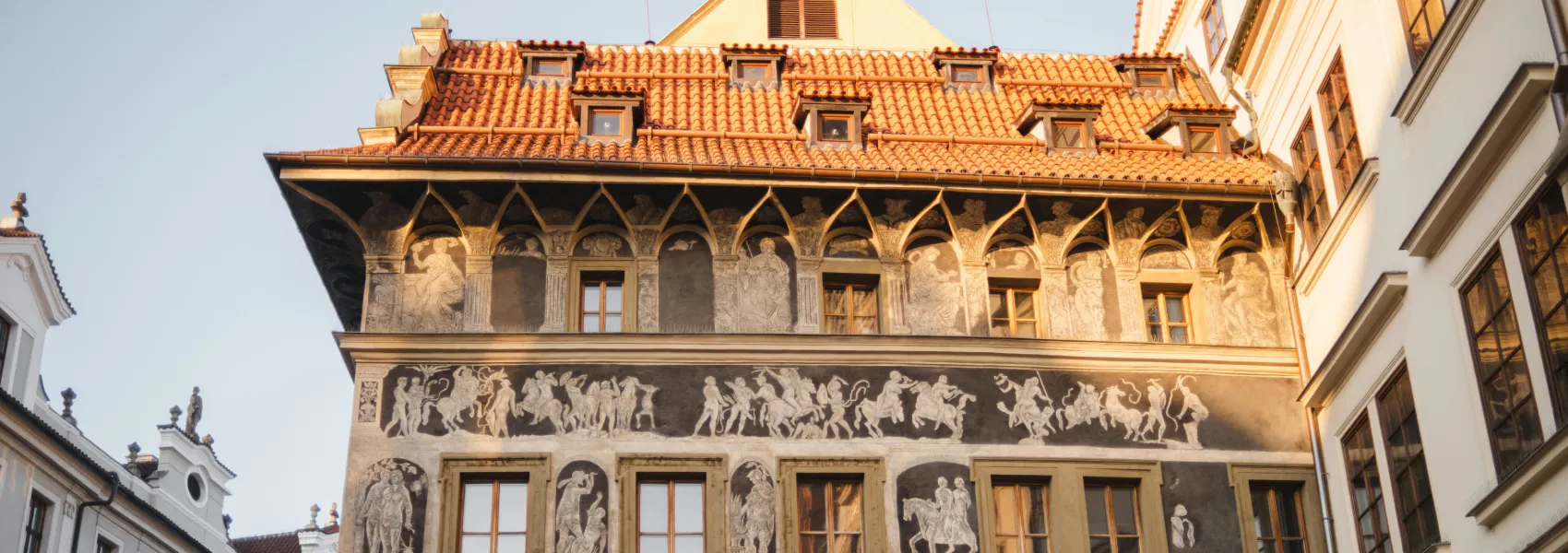
Brown, a master of symbolism and hidden histories, found in Prague a city that seems tailor-made for his stories: a city of Charles IV and Rudolf II, a city of Kabbalah and alchemy, of the Golem and Faust, a city where astronomers once strolled across Charles Bridge and knights slept in the cellars of age-old churches. Prague offered Brown both backdrop and soul, and he transformed it into a literary map that readers from around the world now follow in search of the real locations described in the novel.
Where Prague Lies and What Defines It
Prague lies at the very heart of Europe, at 50°05' north latitude and 14°30' east longitude, within the varied terrain of the Prague Basin. The River Vltava flows through it, shaping the city's panorama as much as its character. Prague Castle rises on the Hradčany promontory at around 250 metres above sea level, Petřín reaches 326 metres, while the level of the Vltava at Charles Bridge lies approximately 182 metres above sea level. This difference in elevation gives the city its unmistakable character.
Prague is today the capital and largest city of the Czech Republic. Approximately 1.3 million people live within its boundaries, while the wider metropolitan area encompasses more than 2 million. It is the seat of the President, the Government, Parliament, and the highest courts. In terms of economic development, it significantly surpasses both the Czech and European average.
Few capital cities in the world are so intimately bound up with the history of their nation. For eleven centuries Prague was the centre of the Czech state, first of the Přemyslid principalities, then of the Kingdom of Bohemia, and on repeated occasions the seat of the Holy Roman Emperors. The historic core of Prague, covering 866 hectares, was inscribed on the UNESCO World Heritage List in 1992 as a unique urban ensemble encompassing Prague Castle with Hradčany, Malá Strana with Charles Bridge, the Old Town with Josefov, the New Town, and Vyšehrad.
Born of Legend: Princess Libuše and Přemysl the Ploughman
Every great city has its founding myth. Prague has Libuše. According to the legend, whose earliest written record appears in the Chronicle of Cosmas (1110–1125), the Czech princess Libuše, a prophetess and the first ruler of her line, climbed a rocky promontory high above the Vltava and declared: "I see a great city, whose glory shall touch the stars." On that spot she commanded a castle to be built and named it Prague. Her husband and co-founder of the dynasty was a humble ploughman, Přemysl, whom the princess chose herself. The Přemyslids then ruled the Bohemian lands for more than four centuries, until 1306.
The name Prague itself has several explanations. Cosmas derives it from the word práh (threshold), with reference to a man who was carving the threshold of his house on the site of the future castle. The philologist Josef Dobrovský in the 18th century proposed a connection with the river rapids on the Vltava. Scholars of the 19th century considered a link to pražení, the burning of forests to clear land for new settlements. None of these interpretations has been definitively confirmed or refuted.
Prehistory and Antiquity: Before the Přemyslids
Settlement of the territory of present-day Prague is attested as far back as seven thousand years ago, with the earliest finds at Křeslice belonging to the Linear Pottery culture. Archaeological discoveries indicate a human presence on Prague's territory even a million years ago, though these were nomadic groups without permanent settlements. Around 200 BC a Celtic oppidum of the Boii tribe arose on the site of today's Závist. Ptolemy's map from the 2nd century AD mentions a Germanic settlement called Casurgis in this area. During the Migration Period in the 6th century, Slavs arrived on the Vltava and settled primarily on the left bank of the river, in the area of today's Malostranské náměstí. In the 9th century the ruling Přemyslid dynasty moved here and had a fortified residence built on the Hradčany promontory, laying the foundations of Prague Castle.
The Romanesque and Gothic Age: From Princes to Kings
In the 10th century the foundations of Prague Castle were laid and the Rotunda of St Vitus was built. Prague was becoming not only the political but also the ecclesiastical centre of the land, and in 973 the Prague bishopric was established. In the 12th century the Judith Bridge rose over the Vltava, a stone predecessor of Charles Bridge, which was eventually demolished after being damaged by ice and replaced with a new bridge.
The pinnacle of Prague's medieval flourishing was the 14th century and the reign of Charles IV (1316–1378), Holy Roman Emperor and King of Bohemia, son of John of Luxembourg. Charles IV elevated the Prague bishopric to an archbishopric, in 1348 founded Charles University, the oldest university in Central Europe, and that same year designed the expansive New Town of Prague and initiated the construction of St Vitus Cathedral. In 1357 the foundation stone of Charles Bridge was laid. The Emperor was a firm believer in numerology, and the date 9 July 1357 at 5:31 in the morning was chosen deliberately: the digits form the palindrome 1 3 5 7 9 7 5 3 1. Under Charles IV, Prague ranked among the foremost cities of Europe.
Hussitism, the Renaissance, and Rudolf II
The 15th century opened a darker chapter. The condemnation and burning of Jan Hus at Constance in 1415 unleashed a wave of unrest in Prague. In 1419 the Hussites seized the city, and Catholic councillors were thrown from the windows of the New Town Hall in the First Defenestration of Prague. The Hussite War broke out, shaking the whole of Central Europe.
After the restoration of order, the Renaissance arrived. The ascent of the Habsburgs to the Bohemian throne in 1526 restored the lustre of an imperial seat to Prague. Yet in 1541 the city was struck by the greatest fire in its history, which consumed much of Malá Strana and Hradčany. Nevertheless, in the second half of the 16th century Prague underwent intensive Renaissance reconstruction and the building of grand noble palaces.
A second golden age came with Rudolf II (1552–1612), who made Prague the centre of European science, art, and occult inquiry. To Prague Castle he invited the leading astronomers of the age, Tycho Brahe and Johannes Kepler, collected works of art, pursued alchemy, and cultivated an interest in hermetic sciences. It is this Rudolfine Prague that is the crucible of the mysticism still permeating the city's atmosphere today. Dan Brown found in it one of the key layers of his novel.
The Defenestration of 1618, in which the royal governors were thrown from the windows of Prague Castle, triggered the Thirty Years' War. The defeat of the Estates' army at the Battle of White Mountain in 1620 and the subsequent execution of 27 Bohemian lords on Old Town Square in 1621 marked the end of the Kingdom of Bohemia's independence and the beginning of religious and cultural oppression. Prague withdrew into itself, and in doing so clothed itself in legends.
The Baroque, the Enlightenment, and the National Revival
The Baroque era brought Prague the construction of magnificent churches, palaces, and gardens, among them the celebrated Wallenstein Garden, the Church of St Nicholas in Malá Strana, and the Clementinum. It also brought wartime drama: in the 18th century Prague endured Franco-Bavarian-Saxon occupation (1741–1742) and capture by the Prussian king Frederick II (1744). In more peaceful times, the Prague of that era became renowned for its rich musical life; it was here that Mozart's operas Don Giovanni (1787) and La clemenza di Tito (1791) had their premieres at the Estates Theatre.
In 1784 Emperor Joseph II united the four historic towns of Prague, Hradčany, Malá Strana, the Old Town, and the New Town, into a single entity. In 1850 Josefov, the original Jewish ghetto, was also incorporated. In the 1840s Prague became the centre of the national revival movement, and in the revolutionary year of 1848 it witnessed a turbulent uprising.
Prague's Legends: A City of the Occult and the Mysterious
Prague is not merely a city of stone and history; it is a city of stories, and many of them balance on the boundary between history and fiction. It is precisely this tension that fascinates Brown and millions of his readers.
Rabbi Judah Loew ben Bezalel and the Golem
The Legend of the Golem is the darkest jewel of Prague's Jewish Quarter. Rabbi Judah Loew ben Bezalel, a genuine historical figure from the turn of the 16th and 17th centuries, is said to have fashioned a humanoid creature from the clay of the River Vltava and brought it to life with the Hebrew word shem, placed in its mouth or forehead. The Golem was to protect the Prague ghetto from pogroms. When the rabbi once forgot to remove the shem on a Friday evening, the Golem ran amok and had to be subdued at great peril. Legend holds that the Golem's remains are still hidden in the attic of the Old New Synagogue.
Faust
The Faust House on Charles Square takes its name from the medieval legend of a learned man who sold his soul to the devil in exchange for knowledge and power. The house is said to have been inhabited by a succession of strange tenants, and researchers have uncovered within it walled-up children's shoes, skeletal remains of cats, and a mysterious opening in the ceiling through which Faust is said to have flown off to hell. One of its historical occupants, the priest Karl Jaenig, collected funerary objects and was nicknamed a vampire by the local people.
Tycho Brahe
Tycho Brahe, the Danish astronomer, came to Prague at the invitation of Rudolf II and became the imperial astronomer. His rival and colleague was Johannes Kepler. Connected with Brahe's death is the Gothic landmark of Old Town Square, the Church of Our Lady before Týn, where he is buried. The legends surrounding his life and death are full of mystery; he is said to have died of mercury poisoning, perhaps deliberate.
Princess Libuše
The Legend of Libuše and Vyšehrad gives Prague its mythological roots. On the Vyšehrad rock the princess uttered her prophecy of the city's glory. Vyšehrad is also the site where, according to legend, the Devil's Column once stood: three stone blocks brought by the devil from Rome to be set into the Church of St Peter and Paul and so disrupt the Mass. The saint outwitted him, however, and the column fell onto the rock, where it remains to this day.
The Legend of Charles Bridge
An old legend of Charles Bridge holds that the masons mixed eggs brought from across Bohemia into the mortar to make the bridge as strong as possible. Modern analysis has not confirmed this, but the story lives on. Associated with the statue of St John of Nepomuk on the bridge is the spot where the saint was cast into the Vltava; touching the relief on the balustrade is said to bring good fortune.
Golden Prague: Architecture for Every Century
Few places in the world bring together so many architectural styles within such a small area. Romanesque rotundas, Gothic cathedrals, Renaissance palaces, Baroque gardens, Art Nouveau cafés, Cubist houses, Functionalism, and contemporary architecture: Prague is a living textbook of the history of art.
Prague Castle
According to the Guinness Book of Records, it is the largest coherent castle complex in the world, covering nearly 70,000 m². It encompasses St Vitus Cathedral, the Old Royal Palace, the Golden Lane, the Basilica of St George, and dozens of other structures. The panorama of the Castle rising above the Vltava is one of the most recognised views in Europe.
Charles Bridge
Completed in the 15th century, it is adorned with thirty Baroque statues of saints, added gradually from 1683 onwards. The Old Town Bridge Tower, which guards it, is considered one of the finest Gothic structures in Europe. The bridge was built by the architect Peter Parler, who also worked on St Vitus Cathedral.
The Astronomical Clock
The Astronomical Clock on the Old Town Hall, dating from 1410, is the oldest still-functioning astronomical clock in the world. Every hour on the hour its doors open and the twelve Apostles file past to the applause of crowds of tourists. The clock displays the positions of celestial bodies, the lunar cycle, and the Old Bohemian time.
Josefov
The former Prague ghetto conceals the Old New Synagogue, the oldest surviving synagogue in Europe (13th century), and the Old Jewish Cemetery, with twelve layers of burials laid one upon another. The cemetery was closed in 1787 and today stands as a place of remembrance for European Judaism.
The Clementinum
The Clementinum, the second largest Baroque complex in Prague (after Prague Castle), houses the celebrated Baroque Library Hall, one of the most beautiful historic libraries in the world, and a tower with an observatory where the longest unbroken meteorological records in Europe have been kept since 1775.
The Strahov Monastery of the Premonstratensians
The Strahov Monastery of the Premonstratensians, above Malá Strana, guards two ornate halls of the celebrated Strahov Library: the Theological Hall and the Philosophical Hall. Their cabinets of curiosities, fresco-adorned ceilings, and the scent of ancient parchment make them among the most photographed interiors in Bohemia.
Vyšehrad
Vyšehrad was the second castle of the Přemyslid princes. Today it is home to the Slavín, the national burial ground where Bedřich Smetana, Antonín Dvořák, Alfons Mucha, Jan Neruda, Karel Čapek, and many others rest.
Literary and Artistic Prague
Prague has inspired world literature in a way that has few parallels in Europe. Franz Kafka spent his entire life here, and it was in the offices and narrow alleyways of the Old Town that the anxiously Kafkaesque vision of a world mired in absurd bureaucracy took shape. Gustav Meyrink set his mystical novel The Golem (1915) in the Prague ghetto, transforming a local legend into a timeless work of world literature. Rainer Maria Rilke was born in Prague and found in its German-language culture the seeds of his cosmopolitan poetics. Jaroslav Hašek wrote his immortal Good Soldier Švejk in Prague's pubs and courtrooms. Milan Kundera captured the soul of Prague during the Prague Spring of 1968 and the ensuing normalisation in novels such as The Unbearable Lightness of Being. And now Dan Brown has added to this pantheon of literature about Prague a novel that pays the city tribute as a cipher key to the world's greatest secrets.
Musical Prague is bound up with Mozart, who loved the city and claimed that Praguers understood his music better than the Viennese. The National Theatre, built with donations from ordinary people, is a symbol of Czech cultural identity in the 19th century. Prague is home to the Czech Philharmonic, one of the world's foremost orchestras, based in the Neo-Baroque Rudolfinum.
Prague in Modern History
In the 20th century Prague passed through dramatic upheavals. In 1918 it became the capital of the new Czechoslovakia. During the Second World War it endured Nazi occupation; the Prague Uprising in May 1945 symbolically closed the war in Central Europe. After February 1948 the communist regime imposed four decades of totalitarian rule. The Prague Spring of 1968, an attempt at reform socialism with a human face, was crushed by the Soviet invasion in August of that year. The Velvet Revolution in November 1989 then peacefully restored democracy, led by the playwright and intellectual Václav Havel.
The great flood of 2002 tested the resilience of the city and its people. Prague weathered it and continued to develop as a modern European metropolis.
Prague Today: A City Between Past and Future
Today's Prague is one of the most visited cities in Europe; in 2017 it attracted 8.5 million tourists and ranked as the fifth most visited city on the continent, behind London, Paris, Istanbul, and Rome. It draws travellers with its world-class monuments, but also with a vibrant gastronomic scene, bustling cafés, contemporary art galleries, and a pulsating nightlife.
Prague is made up of 22 municipal districts, each with a very distinct character: the historic Hradčany and Malá Strana with their perennial tourist atmosphere, elegant Vinohrady with its Art Nouveau architecture, the anarchic Žižkov with its celebrated television tower adorned with sculptures of crawling babies by David Černý, the former industrial Holešovice transformed into a hub of art and design, the tranquil Dejvice, or the villa-lined Bubeneč.
Modern architecture interweaves with the historic fabric of the city: the Dancing House by Frank Gehry and Vlado Milunić (1996) on the Vltava embankment has become an icon of this dialogue. Development projects, new museums, and the restoration of historic buildings continually reshape the face of the city.
Prague is also an important scientific and academic centre. Charles University, the third oldest continuously operating university in Europe, educates more than 50,000 students. The city is home to dozens of research institutions and is attracting an ever-growing number of technology start-ups and international companies.
Prague as Cipher: Why Brown Had to Come Here
Prague is in a certain sense the ideal novelistic setting: it is a city where alchemy meets astronomy, Kabbalah meets Christianity, the Middle Ages meet the Enlightenment, and myth meets history. Here still stand the houses where Rudolf II held counsel with astrologers; here Kafka wandered his dreamlike alleyways; here the figures on the astronomical clock stir every hour, as though time in Prague runs by its own rules. A city that has written its history and its legends into stone, into the parchment of its libraries, and into the architecture of its bridges and churches is itself an inexhaustible source of stories. And that, precisely, is Prague.