The Clementinum
Medieval Origins: The Dominican Monastery
The history of the site where the Clementinum stands today reaches deep into the Middle Ages. As early as the eleventh century, a Romanesque chapel dedicated to St Clement stood here, giving the entire complex its name. Around 1226–1227, the Dominicans arrived in Prague and settled near the church of St Clement close to Judith Bridge. A monastery soon began to grow around it, gradually becoming one of the most significant in the Bohemian lands.
The Monastery's Flourishing
The monastery quickly outgrew its purely religious purpose and became an important centre of learning and political life. The Dominicans built a renowned school of theology that became one of the pillars of Prague's university. Among those who lectured here was Kolda of Koldice, author of key texts in the Passional of Abbess Cunigunde, and the monastery was also visited for an inspection by one of the most celebrated names in medieval mysticism – Meister Eckhart. From 1383, the monastery hosted a studium generale for the entire order, attached to the university. The spacious refectory, measuring approximately 37 × 10 metres, hosted solemn council sessions, trials, and important political negotiations. In 1248 a chapter of the order's province was held here. In 1281, representatives of the Bohemian nobility led by the Prague bishop Tobias of Bechyně gathered in the refectory to discuss remedying the troubled state of the kingdom following the death of Přemysl Otakar II. In 1296, the second-born son of King Wenceslas II was buried in the conventual church, and in 1317 peace negotiations took place here between the parties of Queen Elisabeth of Bohemia and Henry of Lipá. In the first half of the fourteenth century, the monastery housed an inquisitorial court and prison. In 1359, a general chapter of the Dominican order was held here in the personal presence of Charles IV, with the monastery hosting representatives of Dominicans from across the world.
The Aftermath of the Hussite Wars
The Hussite Wars dealt a devastating blow to the monastery. In August 1420 it was burned and the monks who had failed to escape were killed. The ruined complex never fully recovered – by the mid-sixteenth century only the prior and two brothers remained. In 1555, Peter Canisius chose this strategically advantageous location at the foot of Charles Bridge as the first seat of the Jesuits in the Bohemian lands. The last Dominicans were given the convent of the Poor Clares at Na Františku in compensation, and on 21 April 1556, the first twelve Jesuits arrived from Rome. A completely new chapter in the history of this place had begun.
From Jesuit College to National Treasury of Knowledge
The story of the Clementinum as a centre of learning began in 1556, when the Jesuits arrived in Prague at the invitation of Emperor Ferdinand I of Habsburg. He granted them the crumbling buildings of the old Dominican monastery at the foot of Charles Bridge, a strategically perfect location on the Royal Route, the main artery of medieval Prague. Construction of the complex took an impressive 170 years, reflecting the transformation of baroque architecture from its early to its high phase. By 1620, the Jesuits had gradually acquired 32 townhouses, 7 courtyards, and 2 gardens through purchase or donation. From this ground grew a complex covering nearly two hectares.
The library tradition on this site is older still: in 1366 Charles IV donated the first manuscripts to the university, and in 1370 he gave a further 114 volumes from the estate of William of Lestkov. Three of these codices are today the oldest items in the holdings of the National Library. In 1622, Charles University came under the administration of the Clementinum, bringing with it extensive library collections. The growing holdings eventually demanded worthy premises, and in 1727 a library hall was completed that to this day ranks among the most beautiful of its kind in the world. After the suppression of the Jesuit order in 1773, its members were forced to leave the Clementinum, but the library and its academic tradition remained. Since 1923 the complex has served as a national library; today it is home to the National Library of the Czech Republic with a collection of more than 7.7 million volumes and the most precious manuscripts published on Czech territory since 1807.
The Most Beautiful Baroque Library in the World
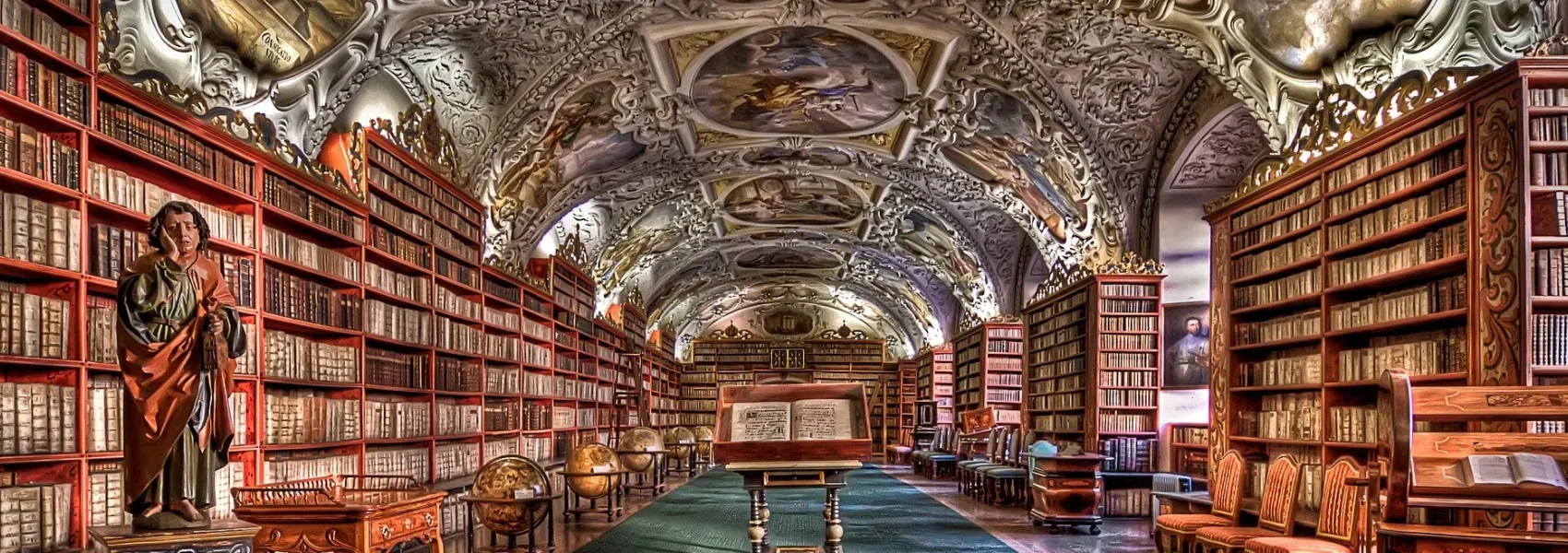
Almost every visitor is immediately struck by the view into the Baroque Library Hall, although to preserve a stable temperature and humidity, guests may only look in from the entrance rather than step inside. The hall is 41 metres long and 12 metres wide. Its vaulted ceiling is adorned with frescoes by Jan Hiebl on the themes of science and the arts; the sides are lined with medallions of prominent Jesuits – including the founder of the Bohemian Jesuit province, Peter Canisius – and a portrait of Joseph II presides at the far end, the emperor who enriched the library with collections confiscated from dissolved monastic libraries. The illusionistic painting of the dome symbolises the Temple of Wisdom.
The oak shelves hold more than 27,000 volumes, largely foreign-language theological literature whose spines, with their whitened strips and red markings, remain virtually unchanged since the days of the Jesuits. The hall is further graced by historically significant large astronomical and geographical globes. Readers of the American website Bored Panda voted this library the most beautiful in the world.
Treasures of the Clementinum Collections
The overall holdings of the National Library in the Clementinum conceal remarkable rarities. The oldest documents are Greek papyri from the third century originating in Hellenistic Egypt; the longest document is a fourteenth-century rotulus measuring more than ten metres. The heaviest book in the collection is the Lobkowicz Gradual, weighing more than 70 kilograms. The most precious manuscript is considered to be the richly illustrated Vyšehrad Codex, comprising 108 parchment leaves and connected with the coronation of the first Bohemian king, Vratislaus I, in 1085. Its historical value is compared to that of the Bohemian Crown Jewels. Among the other rarities is the Liber Sapientiae, a mysterious book of sorcery written in German and Latin and devoted to theoretical magic, kabbalah, and alchemy, as well as collections of Persian and Arabic manuscripts and Sanskrit texts written on palm leaves.
The Astronomical Tower
The dominant feature of the entire complex is the 68-metre-tall Astronomical Tower, built in 1722 and crowned with a lead statue of Atlas carrying the celestial sphere, crafted in the workshop of Matthias Bernard Braun. Reaching the gallery requires climbing 172 steps – there is no lift for visitors – but the effort is well rewarded: from the observation deck at 52 metres, one of the finest panoramas of Prague's historic centre unfolds.
The Meridian Hall
On the second floor of the tower lies the Meridian Hall, a unique space where the exact moment of true noon was determined from 1842 until the early twentieth century. A ray of sunlight passing through a narrow aperture and striking a taut string (working on the principle of a camera obscura) allowed astronomers to pinpoint local noon with precision – more precisely, in fact, than the meridian line on Old Town Square. Built into the walls of the hall are two original astronomical instruments – wall quadrants used to measure the positions of stars. Access to the tower also includes a small exhibition of historic measuring instruments.
The Clementinum holds a remarkable place in the history of meteorology as well. Systematic measurements began in 1775 and have continued without interruption ever since – this is the longest continuous series of meteorological observations in Central Europe, and one of the longest in the world. The highest recorded temperature was 37.8 °C (27 July 1983); the lowest was −27.6 °C (1 March 1785).
Mozart, Einstein, Tycho Brahe and the Codex Gigas
The walls of the Clementinum are steeped in history. The Jesuits were inspired by the renowned astronomers who had worked in Prague – Tycho Brahe and Johannes Kepler – and established an observatory here under the direction of the mathematician and physicist Joseph Stepling. Wolfgang Amadeus Mozart himself visited the Clementinum, and in return for the local students performing one of his symphonies, he delighted them with his own musical performance. Albert Einstein also lectured in the Clementinum's halls during the years 1911–1912, when he served as professor of theoretical physics at the German University in Prague. In 1791, the complex hosted the Waarenkabinet exhibition, one of the first industrial exhibitions in Europe.
The Clementinum also holds the legendary Codex Gigas, known as the Devil's Bible, the largest medieval manuscript in the world, which Dan Brown references in his novel. The original is today kept in Stockholm, but copies and records of this monumental work form part of the rich cultural heritage of the Clementinum.
The Clementinum in The Secret of All Secrets
The Clementinum is not merely a backdrop in Dan Brown's novel – it is the story's heart. This is where the most pivotal scenes unfold: a dramatic chase through the halls and corridors of the complex, the search for the Codex Gigas, and the crucial moment when Robert Langdon finds the story's heroine. Brown was captivated above all by what he called the "historical purity" of the place. The library with its secret passageways plays an unmistakable role in the novel.
The writer visited Prague six times before the novel's publication, and the Clementinum was always his first stop whenever he arrived in the city. He kept his visits in strict secrecy – on one occasion when he was given access to the inner spaces of the library, his identity was deliberately concealed from the security staff. Across the entire Clementinum, only four people knew about the famous visit.
Practical Information for Visitors
The Clementinum is located at Mariánské Square 190/5, Prague 1, in the immediate vicinity of Charles Bridge and Old Town Square, directly on the Royal Route. Guided tours take in the Baroque Library Hall, the Meridian Hall, and the ascent of the Astronomical Tower. Tours run regularly in both Czech and English (Czech tours every Sunday at 11 a.m.). Tickets are best purchased in advance via the prague.eu portal. Reaching the observation gallery of the Astronomical Tower requires climbing 172 steps – no lift is available. The Mirror Chapel hosts regular chamber concerts.