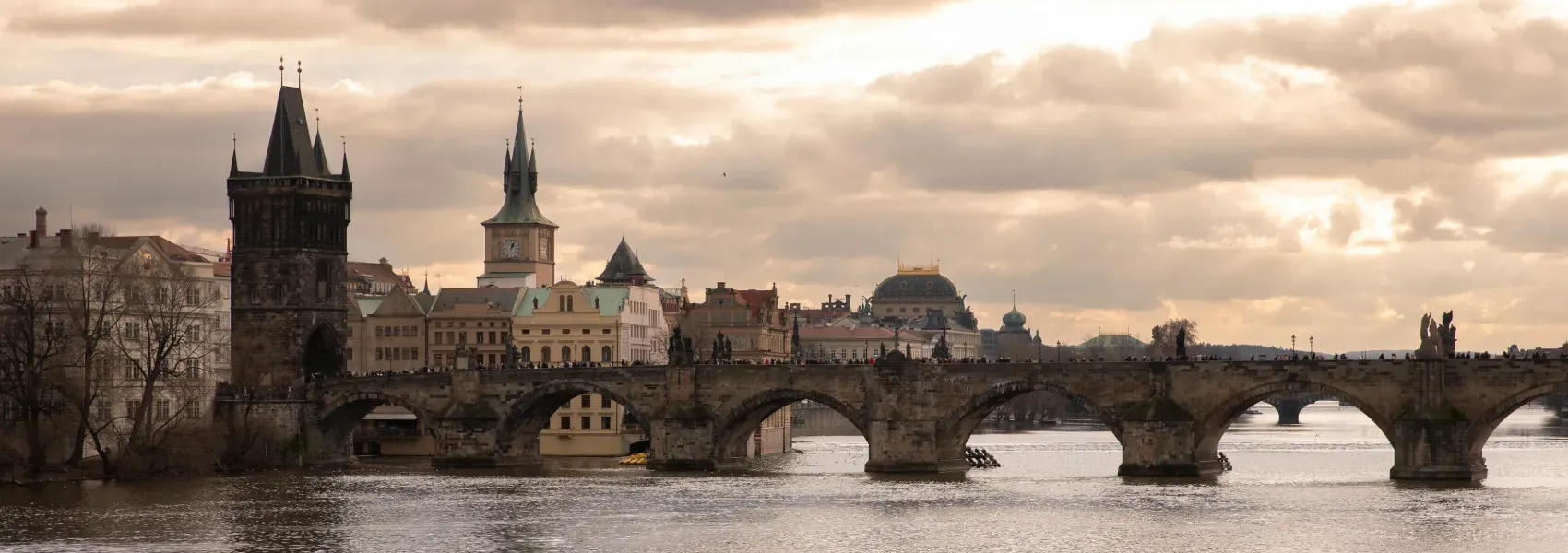
Charles Bridge
A Gothic Bridge with a Mathematical Secret
Construction of Charles Bridge began on 9 July 1357 – and that date was no accident. The foundation stone was laid by Emperor Charles IV himself at a precisely calculated moment: 9 July 1357 at 5:31 in the morning. Written out as a sequence, the date and time form a palindrome of odd numbers: 1-3-5-7-9-7-5-3-1. For medieval astrologers and numerologists, this was a perfectly mirrored, ideal number – and precisely such numbers were believed to grant a structure protection and eternity. At the same moment, a rare astronomical conjunction of Saturn and the Sun occurred in the sign of Cancer, while the constellation of Leo – the heraldic symbol of Bohemian kings – was rising on the ascendant. Dan Brown could hardly have wished for a better prop for his story.
History: From the Judith Bridge to Charles's Pillars
Charles Bridge was the second stone bridge across the Vltava in Prague. It was preceded by the Romanesque Judith Bridge, built approximately between 1158 and 1172 and named after the wife of King Vladislaus II, Judith of Thuringia. The Judith Bridge was so badly damaged by flood and ice in 1342 that an entirely new bridge had to be built.
Construction was first led by Master Otto (magister pontis pragensis), and after his death in 1375 it was taken over by the renowned Petr Parléř, the builder of St. Vitus Cathedral. Parléř brought the project to an advanced stage – the Old Town Bridge Tower is also attributed to him and is regarded as one of the masterpieces of Central European Gothic architecture. The bridge as a whole was roughly completed around 1411.
Compared to the Judith Bridge, the new structure was considerably more imposing: the road surface was raised by four to five metres and the number of piers was reduced from twenty to sixteen. Until the mid-nineteenth century, the bridge was simply known as the Stone Bridge or the Prague Bridge. The name Charles Bridge only became established around 1870, largely due to a suggestion by the journalist and poet Karel Havlíček Borovský.
Building Material: A Story in Stone
Few visitors realise what the bridge is actually made of. The core of the piers and arches is built from quarried Petřín marlstone set in lime mortar, while the outer shell consists of sandstone blocks sourced from various parts of Bohemia – demonstrably from Žehrovice in the Kladno region, from Horoušany near Prague, and from the surroundings of Kostelec nad Labem and Brandýs. Stones from the ruins of the neighbouring Judith Bridge were very likely incorporated as well. During major repairs following the flood of 1890, Hořice sandstone was used, and during the general reconstruction of 1966–1975, Božanov sandstone from the Broumov region was employed. The current paving dates from 1974–1975 and combines grey granite from Boršov near Jihlava with pinkish granite from Zderaz.
The Statues: A Baroque Gallery in the Open Air
The bridge is adorned with thirty sculptural groups and statues arranged along both balustrades. They were created gradually from the late seventeenth to the early eighteenth century and together form a unique open-air Baroque gallery. Most of the statues on the bridge today are copies – the originals are kept safe in museums and depositories to protect them from weathering and air pollution.
The only bronze statue is that of St. John of Nepomuk, patron of the bridge and of Bohemia. One of Prague's most celebrated legends is tied to this spot: King Wenceslaus IV had John of Pomuk thrown from the bridge into the Vltava on 20 March 1393. It is said that the place where he fell into the water was illuminated by stars – hence the five stars in his halo. The relief on the base of the statue has been polished bright by the touch of thousands of pilgrims and tourists over the centuries, all of them believing it will bring good luck and grant a wish.
A Bridge at the Crossroads of History
Charles Bridge has witnessed many pivotal moments in Czech history. In 1409, following the issuing of the Decree of Kutná Hora, several thousand German professors and students left Prague across this bridge. In 1648, citizens of Prague defended the bridge against Swedish forces – the artillery fire damaged the Old Town Bridge Tower so severely that it had to be rebuilt. The bridge also survived the great floods of 1432, 1784, and 1890, each time sustaining serious damage.
The bridge lies along the historic Royal Route – the ceremonial path followed by coronation processions of Bohemian kings, leading from the Municipal House through the Old Town, across Charles Bridge and through the Lesser Town, all the way up to Prague Castle.
Practical Information
Charles Bridge is open to pedestrians around the clock and free of charge. The most atmospheric experience is at dawn or late in the evening, when the crowds thin out and the bridge regains its mysterious quality – the very same atmosphere that Dan Brown captured in his novel. Bridge towers with viewing platforms stand at both ends of the bridge; entry to the towers is ticketed.
Just next to the Old Town bridgehead, on Křižovnické náměstí, the Charles Bridge Museum offers a detailed look at the history of the structure, its sculptural decoration, and the dramatic floods it has endured.
Address
Charles Bridge, Prague 1
Getting There
Metro Staroměstská (Line A), tram stop Karlovy lázně
Bridge Access
Free of charge, open 24 hours a day
Bridge Towers
Entry fee applies – see current pricing