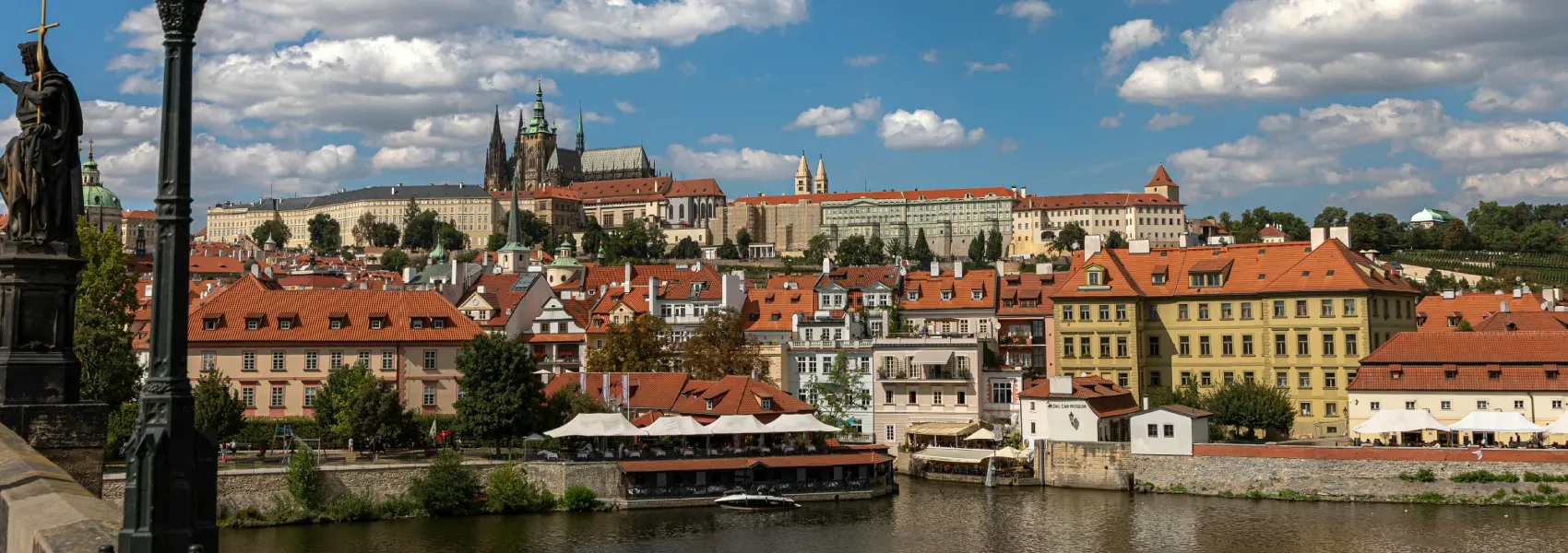
Prague castle
The castle's origins date to around 880 AD, when the Přemysl prince Bořivoj founded a fortified settlement on this promontory. The early medieval stronghold was initially protected by nothing more than a ditch and an earthen rampart, the first stone structure was the Church of the Virgin Mary, whose remains can still be seen beneath the castle courtyards today. In the first half of the 10th century, the Basilica of St George – the oldest surviving sacred building in Prague – and the Rotunda of St Vitus were added, the latter being the seed from which the cathedral would eventually grow. From the 10th century onwards, the castle served not only as the residence of Bohemia's princes and later its kings, but also as the centre of ecclesiastical authority, the first monastery in Bohemia, a Benedictine convent at the Basilica of St George, was founded here.
Prague Castle reached its greatest glory under Charles IV in the 14th century, when it became the imperial seat of the Holy Roman Empire for the first time. Charles IV commissioned a sweeping reconstruction of the Royal Palace and reinforced the castle's fortifications. Modelled on the soaring Gothic cathedrals of France, St Vitus Cathedral began to take shape during this period – the building that would become the defining symbol of the entire complex. Charles IV laid the foundation stone in 1344, following the elevation of the Prague bishopric to an archbishopric; the principal architects were Matthias of Arras and, after his death, Peter Parler. The cathedral was not completed until 1929.
After the turbulent years of the Hussite Wars, during which the castle stood largely empty and fell into disrepair, new life came with the Jagiellonian dynasty after 1483. New defensive towers were built along the northern wall – Daliborka, the Powder Tower (Mihulka) and the New White Tower. The Renaissance transformation of the castle reached its peak under Emperor Rudolf II, who took up permanent residence here and turned the complex into a magnificent centre of the empire that drew diplomats, artists and scholars from across Europe. Rudolf established the northern wing of the palace with the Spanish Hall to house his vast collections of art and scientific curiosities, and it was here that the renowned astronomers Tycho Brahe and Johannes Kepler carried out their work.
The last major reconstruction of the castle took place in the second half of the 18th century, when architect Nicola Pacassi gave the entire complex the unified Baroque-Classicist appearance it retains today. After the founding of Czechoslovakia in 1918, the castle became the official residence of the country's president. The architect Jože Plečnik subsequently made a series of thoughtful additions and refinements to the grounds in the years that followed.
Architecture and Key Highlights
The castle complex encompasses more than seven hundred rooms, and its buildings represent virtually every architectural style of the past millennium – from the Romanesque structures of the 10th century through Gothic, Renaissance and Baroque to the modern architecture of the 20th and 21st centuries.
The centrepiece of the entire site is St Vitus Cathedral, a Gothic three-nave structure visible from much of Prague. The cathedral serves as the burial place of Bohemian kings, including Charles IV, and is also where the Czech Crown Jewels are kept. The Vladislav Hall of the Old Royal Palace, measuring 62 metres in length, was the largest secular room in Europe at the time of its construction and is still used today for presidential inaugurations. Tucked between the Romanesque and late Gothic buildings is the charming Golden Lane, a row of colourful tiny houses set against the castle walls, with the Daliborka Tower and Romanesque cellars dating back to the 12th century. The Romanesque Basilica of St George stands adjacent to the early Renaissance St George's Convent, now home to the National Gallery. The castle's gardens – the Royal Garden, the Paradise Garden and the Stag Moat – offer sweeping views across Prague that Dan Brown described as resembling a fantasy film set.
Prague Castle in The Secret of Secrets
Dan Brown chose Prague as the setting for his novel largely because of its unique atmosphere, poised at the crossroads of science and mysticism. In one interview he explained: "I knew I was going to write about human consciousness, and human consciousness and mysticism are truly at the heart of Prague, going all the way back to Rudolf II." It is precisely the Prague of Rudolf's reign – with its alchemists, astronomers and seekers of hidden knowledge – that forms the historical backdrop to the entire story.
Prague Castle appears in the novel as one of the key locations through which Professor Robert Langdon moves during his frantic search for the missing Katherine Solomon. For Brown, the castle represents centuries of accumulated power, learning and secrecy – the perfect setting for the mysteries Langdon is called upon to unravel. The view of the castle's silhouette from Charles Bridge, which Brown evokes repeatedly in the novel, became one of the book's central visual motifs, the author himself has said that it was precisely this view of the towers rising above the Vltava that convinced him Prague was the right place for the story.
The Rudolphine era of the castle – with its blending of science, alchemy and the occult – resonates deeply with the novel's central theme: the boundary between scientific knowledge and what lies beyond ordinary understanding. Langdon's visit to the castle is therefore not merely a sightseeing detour, but a descent into the layers of history that gave Prague its enduring reputation as a city of mystery.
Visitor Information
The Prague Castle complex is open year-round. The courtyards and gardens are free to enter; admission tickets are required for individual attractions (St Vitus Cathedral, the Old Royal Palace, Golden Lane, the Basilica of St George, the Picture Gallery and others). The ceremonial Changing of the Guard, complete with fanfares and the exchange of the presidential standard, takes place every day at noon on the First Courtyard, the guards change at their posts on the hour, every hour, from 7:00 to 20:00. Visitors who wish to experience the castle without the crowds can arrange early morning or evening tours outside regular opening hours.
The most convenient way to reach the castle is by tram to the Pražský hrad or Pohořelec stop, or on foot via Malostranské náměstí and Nerudova Street – a route that winds through the historic heart of Malá Strana and offers the very views Brown describes in his novel.
Address: Hradčany, 119 08 Prague 1
Website: www.hrad.cz