Robert Langdon arrives in Prague at the invitation of his girlfriend, scientist Katherine Solomon, who is completing a controversial manuscript on the nature of human consciousness and noetics and is preparing to lecture at Prague Castle. The tranquil visit is brutally shattered by a murder, Katherine mysteriously disappears along with her manuscript, and Langdon finds himself caught in a deadly game. On his heels are not only a mysterious assailant who seems to have stepped straight out of Prague's legends, but also the American CIA, whose secret research project in Prague is connected to Katherine's work, and Czech intelligence.
Langdon's search leads through Prague's alleyways, forgotten crypts and underground spaces. Against the backdrop of the story, the legend of the Golem interweaves with the mystical tradition of Rudolfine Prague and provocative questions about human consciousness: can the mind transcend physical reality? Compared to previous instalments in the series, there is less classical symbology and architecture, and the book reads more as a spy thriller with elements of science fiction, in which secret services and scientific experiments at the edge of knowledge take centre stage.
Key Prague locations that play a role in the book
Dan Brown described Prague as the "mystical capital of Europe" and set the story across a number of real locations. He visited the city at least seven times in order to become intimately acquainted with its atmosphere and hidden corners.
Charles Bridge
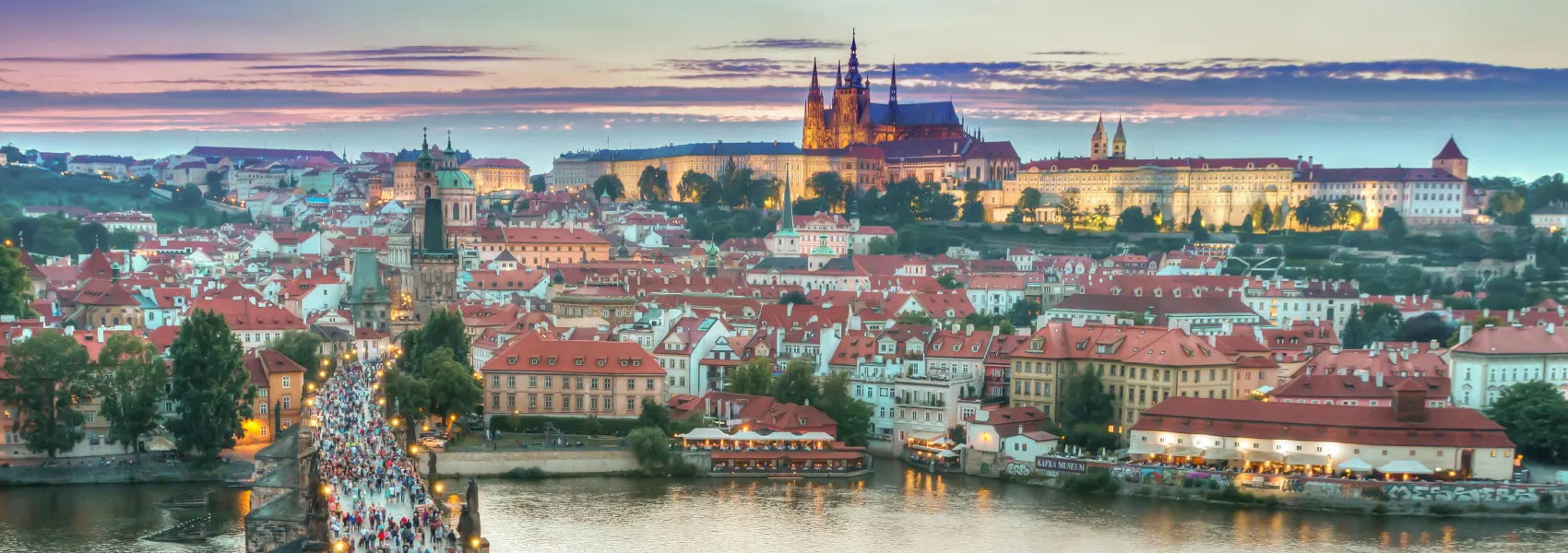
Langdon runs across the bridge every morning from the Four Seasons hotel in the direction of Petřín and Strahov. For him, the bridge is more than a tourist attraction; it becomes a place of daily ritual and quiet reflection amid the hectic pace of the story. One of the novel's key scenes takes place at the cross commemorating the drowning of Saint John of Nepomuk in the Vltava, a place where Prague's legend merges with the present and where Langdon receives an important clue.
The bridge also appeared on the cover of the Czech edition of the book, and Brown called it his favourite place in Prague. It is no wonder: in winter Prague, when it is not crowded with tourists, the bridge radiates exactly the kind of mystical atmosphere that Brown evokes in the novel.
Clementinum
The Baroque library, which Brown considers one of the most beautiful in the world, is one of the most important settings in the novel. It is the place where the story reaches its climax: a dramatic chase unfolds through the historic corridors and halls, the search for the Codex Gigas (the Devil's Bible) yields new clues to the mystery of the manuscript and the secret project, and most importantly, it is here that Langdon finds the female protagonist once again.
Brown visited the library in person and praised its "historical purity", a place that has continuously served knowledge and learning for centuries. This continuity becomes symbolically significant in the book.
Old Town Square and surroundings
Old Town Square is where two parallel plot lines intersect, gradually woven together as the novel progresses. At the Hotel U Prince and its celebrated Black Angels bar, the mysterious figure of the Golem appears repeatedly, using a computer there to search for the address of the secret research centre that lies at the very heart of the conspiracy. Meanwhile, Langdon and Katherine find temporary shelter from a sudden downpour in the Kinský Palace, where they have a moment to assess what they have discovered so far. The square thus functions in the book not merely as a backdrop, but as a living space where different forces pursue different goals without any knowledge of one another. The square is also where the book went on sale, with the first copies sold directly at Old Town Hall.
The Jewish Quarter (Josefov)
Langdon walks through the streets of Josefov, drawing on the rich layers of Prague's Jewish mysticism that permeate the entire novel. The Old-New Synagogue, one of the oldest surviving synagogues in Europe, is the place to which the Golem returns to reminisce about the chair where Rabbi Löw, his creator, used to sit.
The Old Jewish Cemetery then serves Langdon as a source of inspiration for understanding the Golem legend: a guardian fashioned from clay, brought to life by the faith and will of his master. This parallel is no accident; the Golem in the novel mirrors one of the story's central characters, the "great protector", and helps Langdon understand that character's motivation.
Mariánské náměstí
One of the most gripping locations in the entire novel. It is on Mariánské náměstí that a dramatic chase unfolds, with Langdon pursued by Czech intelligence, which has positioned snipers on the rooftops of the surrounding buildings.
Cornered with no apparent escape, Langdon resorts to the only option available: he hides inside one of the two monumental sculptures by the sculptor Ladislav Šaloun, standing beside the City Hall building. Rabbi Löw and the Iron Knight, two iconic figures from Prague's legends, thus literally provide the professor with shelter. It is one of those moments that readers from Prague will particularly appreciate; Brown works with the real topography of the square with great precision.
Hotel Four Seasons
Langdon's luxurious base on the banks of the Vltava. The hotel provides him with a home base and a starting point for his morning runs to Petřín and Strahov, though the calm does not last long. One of the action sequences originates at the hotel, involving a jump from a window towards the river, a moment that amused many Czech readers who know perfectly well the actual distance between the building and the surface of the Vltava. Brown deliberately employed this dramatic licence for the purposes of the story.
Prague Castle
At the opening of the story, Prague Castle is the venue for Katherine's lecture in the Vladislav Hall, a magnificent Gothic space with its characteristic ribbed vaulting, whose beauty Brown describes with evident admiration. The lecture, intended to introduce Katherine's controversial manuscript on consciousness to the academic world, never reaches its conclusion; it is here that the chain of events is set in motion. St. Vitus Cathedral likewise made a deep impression on Brown and in the novel adds to the prevailing atmosphere.
Petřín
The Petřín Lookout Tower, Paris's Eiffel Tower in a Prague scale, is part of Langdon's morning running routes from the hotel. Brown also mentions it in the novel as an alternative for visitors who wish to experience Prague from a height without braving the crowded towers in the city centre. Petřín represents the quieter, more intimate face of the city, and it is precisely this quality that makes it, in the book, a place where Langdon can think in peace, at least for a while.
Strahov Monastery
The destination of Langdon's morning runs, where he goes every day for a swim in the old pool. Strahov Monastery and its surroundings thus function in the novel as a space of regular routine and physical renewal, a counterpoint to the chaos that runs through the entire story. Brown himself singled out Strahov Monastery as one of his favourite places in Prague, and its inclusion in Langdon's daily routine is clearly a personal tribute to the place.
Bastion u Božích muk and Folimanka Park
This lesser-known location in the Karlov district is the setting in the book for highly dramatic scenes in the underground spaces of an atomic shelter. It is here that the secret research project, which stands at the centre of the entire story, is housed, and as the editor of publisher Argo noted, "anyone who reads the book will understand why the plot could not have been set anywhere else". The choice of location is no coincidence: an abandoned Cold War bunker hidden beneath a park where children play offers a perfect contrast between apparent normality and what lies beneath the surface, in both the literal and figurative sense.
Wallenstein Garden
Brown personally mentioned Wallenstein Garden as one of his favourite places in Prague, expressing particular admiration for its unique stalactite wall, a geological curiosity set within a Baroque garden. In the novel, the garden functions as a space of silence and hidden beauty, one of those corners that most tourists pass by, yet which lend Prague its distinctive, multilayered character.
Vyšehrad
Another of Prague's iconic locations that appears in the novel, adding to the mosaic of sites spread across the city. Vyšehrad, with its position above the Vltava, its old cemetery of distinguished Czechs, and its layers of legendary antiquity, naturally aligns with Brown's vision of Prague as the "mystical capital of Europe". In the story it represents the dimension of ancient Czech identity, a silent witness looking on as a modern drama unfolds.