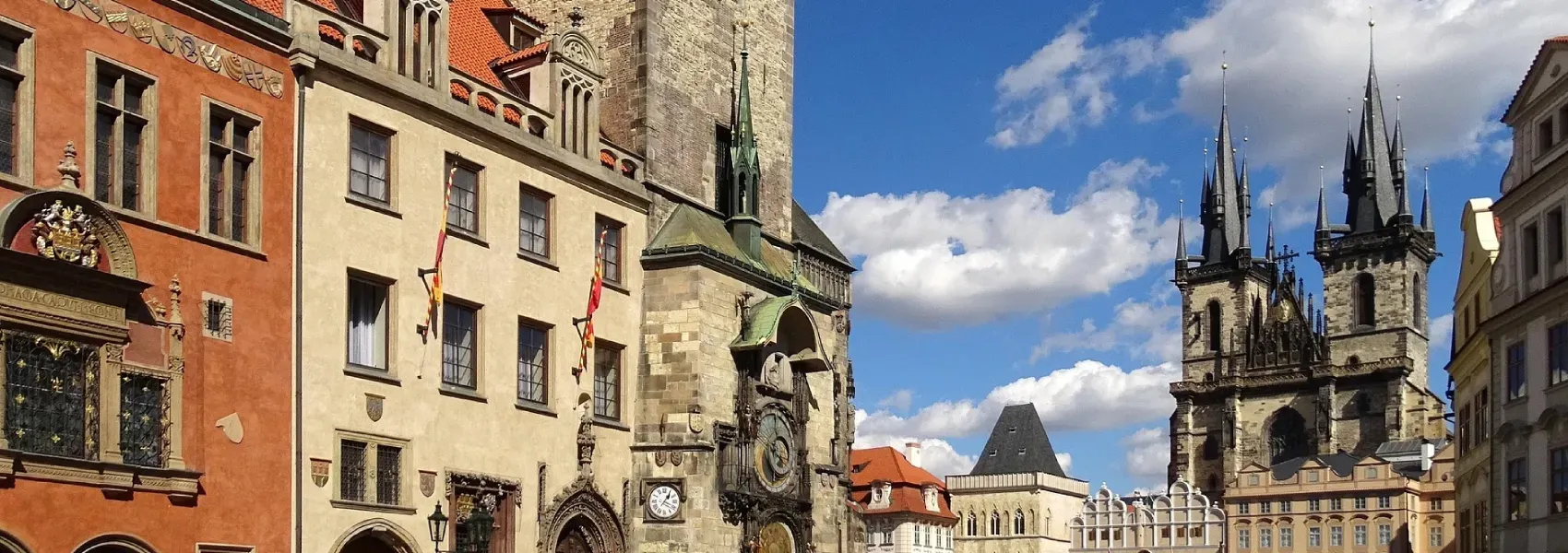
Old Town Hall
Robert Langdon himself recalls how, on their first day in Prague, he and Katherine Solomon ducked out of the rain into a passageway of the Kinský Palace right on Old Town Square, and there, breathless and within sight of the clock, kissed for the very first time. Old Town Square thus serves in the novel as the emotional centre of the entire Prague story — a place where the city's ancient legends intertwine with the personal fate of its main characters. Fittingly symbolic, too, was the book's launch: on 9 September 2025, the first copies of The Secret of All Secrets went on sale in the premises of the Old Town Hall itself, and the first hundred buyers received a copy bearing the author's signature.
History
The Old Town Hall came into being by decree of King John of Bohemia, who in 1338 granted Prague's Old Town the right to establish its own administrative centre. Its foundation was a corner Gothic house belonging to the wealthy merchant Wolflin of the Stone, built in the late thirteenth century and standing on the Great Market — today's Old Town Square. In 1364 a massive prismatic tower, nearly seventy metres tall, was added to the house and became the unmistakable landmark of the entire square.
From the outset the town hall grew by gradually absorbing neighbouring buildings. The Gothic chapel dedicated to the Virgin Mary and the four patron saints of Bohemia was consecrated in 1381. Less than thirty years later, in 1410, the clockmaker Mikuláš of Kadaň together with the astronomer Jan Šindel installed an astronomical clock on the south face of the tower — the Prague Orloj. Around 1490 the mechanism was refined by the clockmaker Jan Růže, known as Master Hanuš. In the late fifteenth and early sixteenth centuries the entire town hall block underwent a Late Gothic remodelling, during which the clock face acquired its present Late Gothic appearance. In the nineteenth century a Neo-Gothic eastern wing was added, and in 1896 the neighbouring House of the Minute, adorned with Renaissance sgraffito, was incorporated into the complex.
The town hall faced its gravest ordeal in the final days of the Second World War. During the Prague Uprising, on 8 May 1945, the Neo-Gothic wing was completely destroyed by Nazi shelling and the subsequent fire; the tower, chapel and clock were severely damaged, and part of the Prague city archive was lost to the flames. The remaining walls of the eastern wing were demolished after the war. The historic southern wing and tower were gradually restored, and a major renovation of the exterior and the clock was carried out between 2017 and 2018.
Stories and Legends
No building on Old Town Square has witnessed as many historical turning points as the town hall. In 1422 Jan Želivský, the charismatic leader of the radical Hussite movement of Prague's poor, was executed before its walls. Six years earlier, in 1419, Hussite rebels stormed the town hall itself and hurled the despised councillors from its windows in the First Prague Defenestration. In 1458 the Bohemian estates assembled in the council chamber and elected George of Poděbrady as King of Bohemia — the only occasion in history when the Czechs freely chose a non-Catholic monarch.
The darkest page in the town hall's chronicle was written on 21 June 1621. After the defeat of the Bohemian Revolt at the Battle of White Mountain, the town hall jail served as a prison for the leading figures of the uprising. On that June day the executioner Jan Mydlář carried out the execution of twenty-seven men on the square directly in front of the town hall — three noblemen, seven knights and seventeen burghers. Twelve of the severed heads were subsequently displayed in iron cages on the Old Town Bridge Tower. Twenty-seven white crosses set into the paving of the square still mark the site of the execution today.
Dozens of legends have wound themselves around the clock since the Middle Ages. The best known tells of Master Hanuš, whom the Prague city council supposedly commissioned to build a unique timepiece on the tower. When the work was complete, the councillors had Hanuš blinded one night so that he could never construct a similar clock elsewhere. Hanuš took his revenge by asking a pupil to lead him to the heart of the mechanism, then reached in and brought the clock to a standstill. According to the legend it took more than a hundred years before the device was set in motion again. The historical truth is different — the clock was built as early as 1410 by Mikuláš of Kadaň working from an astronomer's calculations, and Master Hanuš contributed to its improvement only decades after its completion — yet the tale of the blinded clockmaker lives on unshakeably in Prague's memory. Alois Jirásek immortalised it in his Old Bohemian Legends, and today every Czech child knows it.
A further legend surrounds the figure of the skeleton on the clock: whenever the clock stops for any length of time, misfortune will befall the Czech nation, and the skeleton confirms this by nodding its head. The only hope, according to tradition, was a boy born on New Year's night, who at the moment the clock started again was to run at midnight from the Týn Church across the entire square to the town hall. Dan Brown captured the clock's role as a prophetic mirror of Czech fate with equal precision: his villainous Golem regards the hourly parade of apostles as a perfect symbol of unthinking human conformity, while for Langdon and Katherine the clock remains part of the enchantment Prague worked upon their relationship.
Architecture and Artistic Highlights
The present town hall complex consists of a row of Gothic and Renaissance houses that merged into a single whole over the centuries. The oldest part, the Wolflin Tower House, is an Early Gothic structure on Romanesque foundations, featuring a richly decorated portal and a window bearing the coats of arms of the Old Town and the Kingdom of Bohemia. The Chapel of the Virgin Mary on the first floor of the tower has a rectangular interior ending in a pentagonal bay; beneath the baldachins of the outer bay stand statues of Bohemia's patron saints, and carved stone coats of arms of the town council members from 1365–1366 are visible on the jambs. On the second floor are the ceremonial halls — the George Hall and the Brožík Hall — decorated with valuable paintings.
The Astronomical Clock
The Prague Orloj consists of three parts. At its centre dominates an astronomical dial derived from the medieval astrolabe, from which four different types of time can be read: Central European, sidereal, Babylonian and Old Bohemian. The clock also shows the movement of the Sun and the Moon through the zodiac and the phases of the Moon. Every hour from eight in the morning until eleven at night two small windows open and the procession of the twelve apostles passes through; meanwhile Death turns his hourglass and rings a bell, while the figures of Vanity, Greed, Avarice and Corruption stand to either side of the dial. Beneath the astronomical dial is a circular calendar plate depicting the twelve months, whose present appearance was designed in the nineteenth century by the painter Josef Mánes. At the top of the tower a golden cockerel crows during the apostles' parade — an addition made during the Art Nouveau restoration in the nineteenth century.
The town hall's underground comprises a series of Romanesque and Gothic cellars that once served as the foundations of the original burghers' houses from the thirteenth and fourteenth centuries. They are accessible on guided tours and also conceal part of a historic sewer, whose system was designed by the British engineer William Heerlein Lindley at the turn of the nineteenth and twentieth centuries.