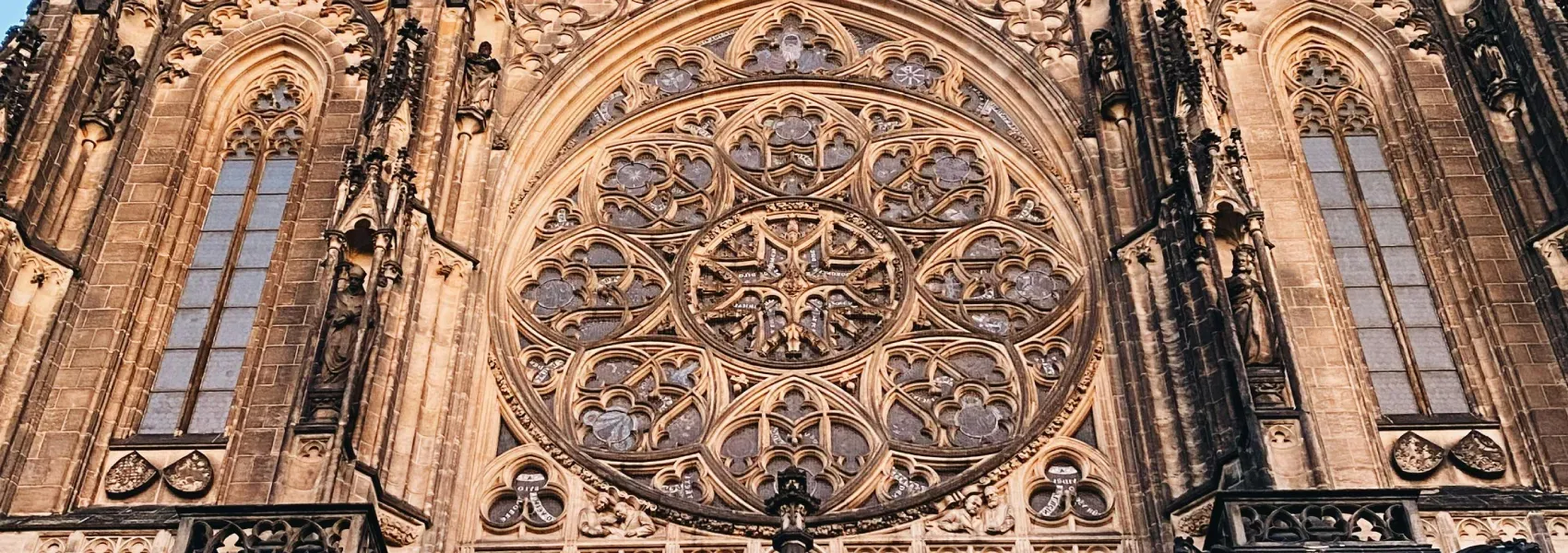
St. Vitus Cathedral
The Cathedral in Dan Brown's Novel
Right from the novel's prologue, readers encounter St. Vitus Cathedral as Prague's foremost landmark. The character of Dr. Brigita Gessner floats high above the towers of the ancient city and, in a sea of flickering lights, sees the cathedral blazing below — this aerial view of the illuminated church opens the entire story and establishes Prague Castle as one of its central settings.
Langdon catches sight of the cathedral repeatedly as he moves through a wintry Prague. In an excerpt from the book it is described as part of the largest castle complex in the world, whose outer walls enclose six formal gardens, four palaces and five Christian churches. In the novel the cathedral is presented as the place where the Czech coronation jewels are kept safe — making it a symbol of power, continuity and the secrets Prague has guarded for centuries. The story's protagonists search here for one of the narrative's symbolic keys.
Dan Brown himself, during his Prague visit in September 2025, admitted that the cathedral had made an extraordinary impression on him, as he told Czech Radio Radiožurnál. That admiration is reflected directly in the way he portrays the church in the novel — as a majestic backdrop that transcends mere architecture and becomes an expression of the spirit of the place.
Historical Background
The history of the cathedral is at the same time a condensed history of the Czech state. As early as around 929, a pre-Romanesque rotunda stood on the site of the present church, built at the order of Prince Wenceslas. In 1060 it was replaced by a three-nave Romanesque basilica. The Gothic cathedral proper was begun on 21 November 1344, when the Bohemian King John of Luxembourg laid the foundation stone in the presence of Crown Prince Charles — the same year in which Pope Clement VI elevated the Prague bishopric to an archbishopric.
Construction proceeded under the direction of two outstanding architects. It was first led by Matthias of Arras, who brought the French Gothic style to Bohemia; after his death in 1352 he was succeeded by Peter Parler, who enriched the project with German influences and gave the building its unmistakable character. Both masters entered not only the history of architecture but also national mythology. Work was interrupted by the Hussite Wars, when Parler's sons sealed the unfinished shell of the cathedral with a temporary timber wall, and the building remained incomplete for centuries. The neo-Gothic completion was undertaken by the Union for the Completion of the Cathedral, founded in 1859. An entire generation of leading Czech and Slovak artists contributed to the work, among them M. Švabinský, A. Mucha, J. V. Myslbek, F. Kysela and others. The definitive completion and consecration took place on 28 September 1929 in the presence of President T. G. Masaryk, exactly 585 years after the laying of the foundation stone.
From its earliest days the cathedral has served as the burial place of Bohemian rulers, saints and the most prominent ecclesiastical figures. The country's patron saints are interred here — Wenceslas, Adalbert and John of Nepomuk. The last coronation held in the cathedral took place in 1836, when Ferdinand V was crowned in St. Vitus.
Architectural and Artistic Highlights
The cathedral is regarded as the most remarkable Gothic building on Czech territory and at the same time as a living encyclopaedia of Czech visual art from the 10th to the 20th century. Its interior and exterior conceal hundreds of works of art from different eras, ranging from medieval stained glass and Gothic chapels to Baroque tombs and contemporary organs.
The Golden Gate
The south facade of the transept is dominated by the Golden Gate, a ceremonial triple-arched vestibule named after the golden background of the monumental Last Judgement mosaic above it. This mosaic in Venetian glass was created around 1370 and ranks among the largest and best-preserved mosaics of its kind north of the Alps. The Golden Gate served as the ceremonial entrance for the coronation processions of Bohemian kings and remains to this day one of the most photographed views of the entire castle complex.
The Towers of the Cathedral
The Great South Tower
The silhouette of the cathedral is defined by three towers, each from a different era and in a different style. The dominant feature is the Great South Tower, whose construction was begun by Peter Parler in 1396. After his death his sons continued the work; the Hussite Wars halted progress and in 1541 the tower was badly damaged by the great fire of Prague Castle. The restoration and Renaissance completion — with an open gallery and a dome — was carried out in 1560–1562 by architect Boniface Wohlmut and master builder Hans Tirol. The Baroque onion dome was replaced in 1770 by the present helmet by Nicola Pacassi. The tower reaches a height of 96.6 metres, making it the third tallest church tower in the Czech Republic. The facade carries two clock faces, one showing full hours and one showing quarter-hours. A Renaissance window on the first storey is adorned with a gilded grille forged between 1568 and 1573 by Jiří Schmidthammer. At the very top stands a gilded double-tailed Czech lion in copper sheet, three metres tall and weighing 120 kilograms. The viewing gallery at a height of 56 metres is reached by 287 steps; on the way up visitors can peer into the cathedral's bell chambers. The tower is open to the public on a separate admission ticket.
The West Towers
The pair of west towers, approximately 80 metres tall, was added during the neo-Gothic completion in 1873–1929 to designs by Josef Kranner and Josef Mocker. Between them lies the cathedral's main entrance, with three portals and massive bronze doors. The west towers have no bells or clocks and are not open to visitors.
The Royal Crypt
Beneath the floor of the cathedral lies the Royal Crypt, the largest burial place of Bohemian rulers anywhere. It holds the remains of fourteen Bohemian princes and kings. Sarcophagi are kept here of Charles IV and his four wives, Wenceslas IV, Ladislaus the Posthumous, George of Poděbrady and Rudolf II. The crypt took its present form during the neo-Gothic completion of the cathedral in the late 19th century, when the remains of rulers were gathered from various locations within the church and brought together here. At the centre of the space stands the Renaissance mausoleum of Maximilian II and Ferdinand I with his wife Anne of Jagiellon, relocated here from the main nave. The crypt is accessible as part of the Prague Castle tour circuit and offers one of the most powerful experiences of the entire visit — a quiet, contemplative space where the history of the Czech state reaches out and touches you directly.
The Chapel of St. Wenceslas
The most precious space in the entire cathedral is the Chapel of St. Wenceslas, built by Peter Parler above the tomb of Prince Wenceslas and consecrated in 1367. Parler vaulted it with a stellar vault unknown at the time, shifting the supports from the corners of the room to the thirds of the walls — a structural innovation that gives the chapel an almost cubic character. The walls are lined with gold and semi-precious stones — amethysts, jaspers and chalcedonies — and decorated with paintings from the 14th and 16th centuries depicting the legend of the patron saint of Bohemia. At the centre of the chapel stands a Gothic baldachin tomb of St. Wenceslas, above which hang a helmet and armour evoking the saint's knightly prowess. Inside the chapel a staircase leads up to the Crown Chamber above.
The Crown Chamber and the Tradition of the Seven Keys
The Crown Chamber is a room above the St. Wenceslas Chapel, its windows looking out onto the facade of the Golden Gate. It is widely regarded as the most inaccessible place in Prague Castle. The chamber door — as well as the armoured safe inside — each have seven locks. To gain entry, all seven key-holders must be physically present: the President of the Republic, the Prime Minister, the President of the Senate, the Speaker of the Chamber of Deputies, the Archbishop of Prague, the Dean of the Metropolitan Chapter of St. Vitus and the Mayor of the City of Prague. The tradition of the seven keys arose in 1791, when King Leopold II granted the request of the Bohemian Estates for the return of the jewels from Vienna and the keys to the crown archive were combined with those to the jewel casket. The identity of the key-holders has changed over the centuries in line with the political order — during the Protectorate, for instance, the Reich Protector held the majority of the keys. This detail of the seven keys directly evokes the spirit of Brown's novel.
The Czech Coronation Jewels
Kept in the Crown Chamber is the set of Czech coronation jewels, one of the most precious and most completely preserved coronation ensembles in Europe. It comprises the Crown of St. Wenceslas, the royal sceptre, the royal orb, the coronation mantle and leather cases. The crown and the coronation cross were commissioned by Charles IV in 1345–1346 for his coronation as King of Bohemia — it is the fourth oldest surviving royal crown in Europe. It is made of high-carat gold and set with precious stones. According to the wish of Charles IV and a papal bull of Clement VI, the crown legally belongs to St. Wenceslas — a ruler could only borrow it for a coronation and was required to return it before sunset on the same day, on pain of excommunication. The crown is inseparably linked with a legend of a curse: anyone who places it on their head without rightful claim will die. Reich Protector Reinhard Heydrich, who allegedly put on the crown in 1941, was killed in an assassination attempt a few months later. The jewels are made accessible to the public only on exceptional occasions, in recent years regularly in September on the occasion of the feast of St. Wenceslas. Copies of the jewels are on permanent display in the permanent exhibition of the Old Royal Palace.
Stained Glass Windows
The stained glass windows form a remarkable gallery of modern art set within a Gothic space. The dominant piece is the rose window by František Kysela depicting the Creation of the World, ten metres in diameter, placed on the west facade. The most significant of the figurative windows was designed by Alfons Mucha in 1931 — his window in the north chapel depicts the lives of the Slavic apostles Cyril and Methodius and stands as one of the high points of his career. Other contributing artists include Max Švabinský and Karel Svolinský. Those who examine the windows closely will discover some of the oldest surviving Prague advertisements — donors who funded their creation had their names or company logos discreetly incorporated into the compositions.
The Silver Tomb of John of Nepomuk
In the south ambulatory of the church stands one of the most lavish Baroque works in Central Europe — the silver tomb of John of Nepomuk, dating from 1736 and designed by Josef Emanuel Fischer von Erlach. The tomb weighs over 1,500 kilograms of solid beaten silver and its rich relief decoration celebrates both the saint's preservation of the confessional seal and his martyrdom. John of Nepomuk was canonised in 1729 and his cult soon spread across Europe. Also worth noting are the bronze entrance doors, which most visitors walk past without a second glance. They depict St. Wenceslas and Charles IV, and the faces of all four principal builders of the cathedral can be found on them — the medieval Matthias of Arras and Peter Parler alongside the modern Kamil Hilbert and Josef Mocker.
The Sternberg Chapel and Traces of the Prussian Siege
In the Sternberg Chapel a cannonball can be seen hanging on display — a curious memento of the Prussian siege of Prague in 1757. Over 23 days some 770 cannonballs struck the cathedral; this particular one caused the greatest damage. Beside it remains an intentionally unrepaired marble balustrade that the ball carried away. It is a visible scar that the cathedral has deliberately preserved as a lasting reminder of those events.
The Zikmund Bell and the Organ
The pride of the cathedral is the Zikmund Bell, the largest bell in the Czech Republic. It was cast in 1549 by Tomáš Jaroš of Brno and decorated with relief portraits of Ferdinand I and Anne of Jagiellon. The bell weighs approximately 15 tonnes and requires six bell-ringers to set it swinging. Its voice rings out on public holidays and religious celebrations. Legend has it that when the bell cracks, hard times await the land — this last occurred in 2002, shortly before the devastating floods. The south tower holds a total of seven bells on two floors, all still rung by hand. The bells are tended by the voluntary society Campanarii Pragenses Sancti Viti. In spring 2025 a new large organ by Spanish master Gerhard Grenzing was installed in the cathedral, with 6,500 pipes and a unique design inspired by the basalt columns of Panská skála. Its ceremonial inauguration is planned for the feast of St. Vitus on 15 June 2026.
Practical Information for Visitors
The cathedral stands on the third courtyard of Prague Castle, which as part of the Historic Centre of Prague is inscribed on the UNESCO World Heritage List. Entry to the cathedral is included in the Prague Castle basic circuit, which also covers the Old Royal Palace, the Basilica of St. George and Golden Lane. The price of the basic circuit is 450 CZK (reduced 300 CZK, family 950 CZK). A ticket for the cathedral alone cannot be purchased — the only exception is the south tower viewing gallery, for which a separate ticket costs 200 CZK (reduced 150 CZK). Tickets are sold at the information centre near the Powder Bridge Gate or at the Old Royal Palace.
Opening hours are from April to October Monday to Saturday 9 am–5 pm, Sunday 12 noon–5 pm. From November to March the cathedral closes one hour earlier. Last admission is always 20 minutes before closing time. Masses are held Monday to Friday at 7:00 am, on Sundays at 8:30 am and 10:00 am. Tourist access is restricted during services. A virtual tour is available on the cathedral's website.
The most convenient way to reach Prague Castle is by metro to Malostranská station (Line A), from where a staircase leads up to the castle complex, or by tram to the Pražský hrad stop (Line 22). Entry to the castle grounds is free of charge; fees are charged only for entry to individual buildings. The cathedral is partially accessible to visitors with reduced mobility — access to the naves is possible, but the crypt and the tower are not accessible.