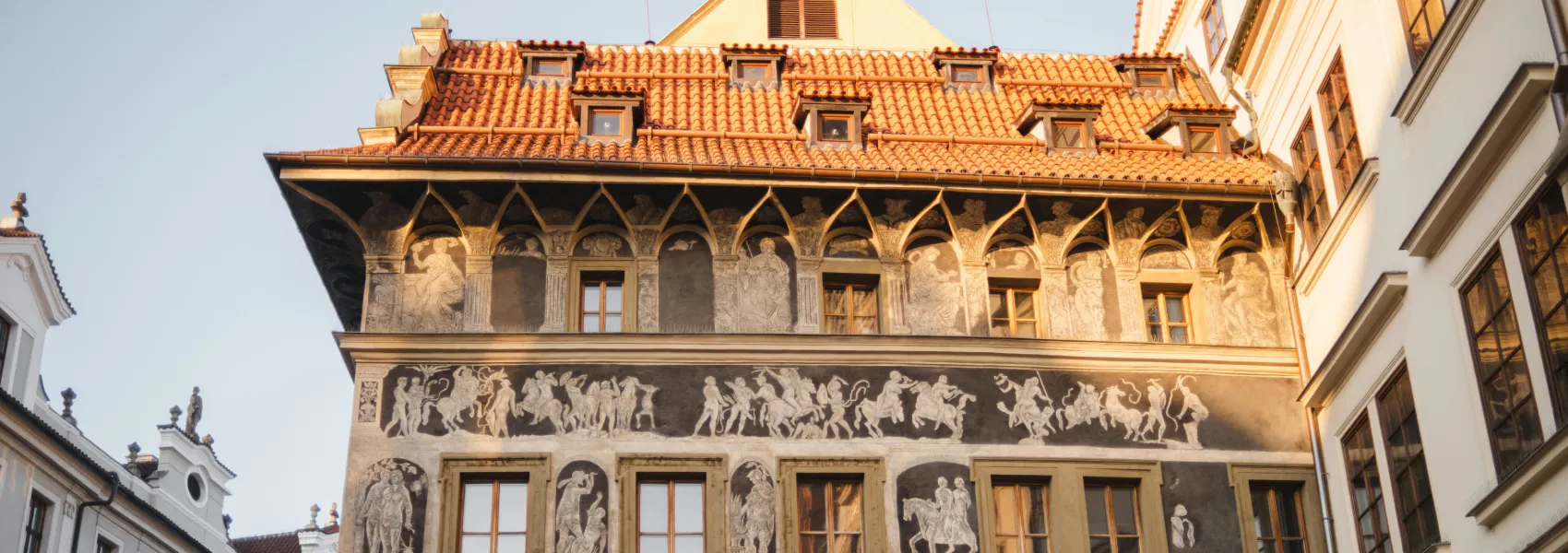
The name High refers to the position of the main prayer hall on the first floor of the Town Hall building, which is why the synagogue was also known as the Town Hall Synagogue. Originally, it was entered directly from the first floor of the Town Hall. It served as the private house of prayer for Jewish councillors and assessors of the beit din (rabbinical court), whose sessions were also held here. By virtue of its administrative character, it was not a public synagogue in the conventional sense, but rather a representative place of worship for the communal self-government.
The synagogue suffered severe damage in the devastating ghetto fire of 1689 and, following its restoration, acquired an early Baroque façade still dominated today by three semicircular windows and a richly profiled Renaissance cornice. At the end of the 18th century it was extended by a late Baroque wing housing the women's section. In the 1880s the interior underwent extensive remodelling to a design by the architect J. M. Wertmüller, during which the building was also physically separated from the Town Hall.
The interior of the synagogue is a remarkable example of Renaissance synagogue architecture. The entrance corridor is covered by a double cross vault, while the main prayer hall features a barrel vault with lunettes whose centre converges into the shape of an eight-pointed star. The walls are articulated by pilasters with Ionic and Corinthian capitals. The focal point of the interior is the early Baroque aron ha-kodesh (Torah ark), crowned by a gilded cartouche with a pair of angel wings. A women's gallery runs along the southern wall.
Services were held in the synagogue continuously until the autumn of 1941, when it was converted into a warehouse under the Nazi occupation. After the war it served as the headquarters of the State Jewish Museum. A full restoration was carried out in 1994–1996, and since 1997 the synagogue has once again fulfilled its original purpose as a house of prayer for the Prague Jewish community. The ground floor of the building houses the ticket office and shop of the Jewish Museum in Prague.
The synagogue is not generally open to the public; regular services are reserved for members of the Prague Jewish community. Group visits with a licensed guide are occasionally possible by prior arrangement with the Prague Jewish Community. Address: Červená 5, Prague 1 – Josefov.